Norval Morrisseau expert tells court Indigenous painter’s family, estate were ‘critical to the success’ of rampant fakes

Updated: Sep 10
By Betsy Powell
Prosecutors have cast Jeffrey Cowan as the mastermind of a complex forgery scheme involving works attributed to one of Canada’s most celebrated artists.
They say Cowan’s role warrants an “exemplary” prison term of eight years for undermining the legacy and reputation of Indigenous icon Norval Morrisseau — the “Picasso of the North,” who died in 2007 — and harming First Nations in Canada through acts of cultural appropriation that “lay at the heart of Cowan’s criminal enterprise.”
But in a rare art forgery sentencing hearing in Barrie this week, Toronto defence lawyers Nathan Gorham and Breana Vandebeek are arguing the truth is far more complicated.
At the centre of their argument is an explosive allegation: that Morrisseau’s adult children have been in on the fraud.
Cowan’s lawyers are presenting a case that his actions are not cultural appropriation because the Morrisseau children — the beneficiaries of his estate — themselves authenticated and promoted forged works for financial gain. The defence is also alleging representatives of the estate assisted in authenticating fake Morrisseaus and are benefiting from the proliferation of forgeries.
It’s a narrative the defence says undercuts the Crown’s portrayal of Morrisseau family and estate as victims, which the prosecution cites as an aggravating factor to justify its bid for a stiff eight‑year sentence.
A statement on the Morrisseau estate’s website says the estate is “very aware of the issues surrounding his art and we will work to bring clarity, justice and confidence back to his collectors.”
Cowan’s crimes “did not injure a single person alone. It wounded a family, a people, a culture and a country,” Cory Dingle, executive director of the Norval Morrisseau Estate Ltd., wrote in a victim impact statement that was initially filed with the court before it was challenged by Cowan’s lawyers ahead of this week’s hearings.
The conviction of forger Jeffrey Cowan
Cowan, 50, was one of eight people arrested in 2023 as part of the largest art fraud investigation in Canadian history. He and the others were connected to various forgery schemes that produced and distributed thousands of counterfeit Morrisseau works. After representing himself at trial, a jury in Barrie last fall convicted the Niagara-on-the-Lake resident of four fraud-related offences. He was the last of the eight to face justice.
The court heard that from 2008 to 2021, Cowan advertised and sold more than 1,400 artworks falsely attributed to Morrisseau. Some sold for tens of thousands of dollars.
It was never established who exactly painted the pieces; many were bad fakes riddled with “red flags,” such as the artist’s signature written in English letters, not Cree syllabics.

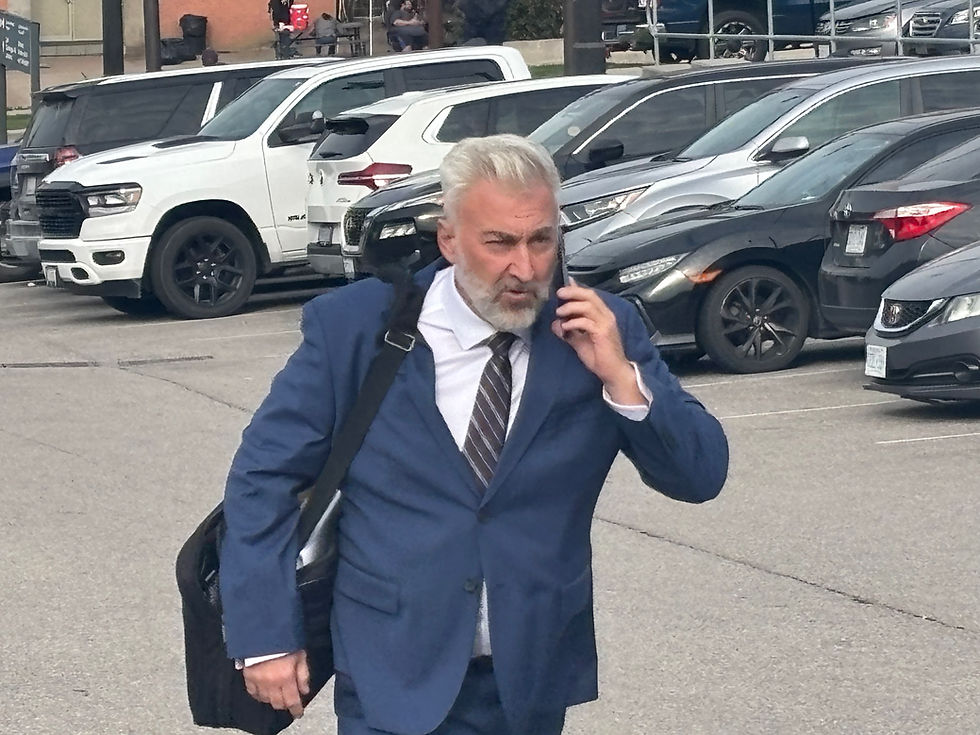
On Monday, Cowan’s defence called John Zemanovich to the stand. He told court he has spent more than 30 years researching Morrisseau’s art and life, and has been a consultant on the topic to collectors, galleries and public institutions. He also owns an authentication and art investigation company, and works with Jonathan Sommer, one of Canada’s leading art fraud lawyers who is watching the proceedings on Zoom.
Zemanovich is not in the witness box because he supports Cowan.
Rather, he testified he felt compelled to testify for the defence because he wanted to make sure “people know the context of what occurred.”
He told Superior Court Justice Laura Bird the involvement of the Morrisseau children was “critical to the success of the fraud.” Otherwise, he said, “I really do not think there’s any way possible it could have reached the size it did.”
In a 338-page affidavit filed with the court, Zemanovich outlines numerous examples that he says demonstrate how, for decades, the children “defended, promoted, participated in and profited from the fraud.”
For instance, he says the Morrisseau Family Foundation, an organization headed by one of the late artist’s daughters, provided certificates of authenticity for reproductions sold by Jim White, who received a conditional sentence of two years less a day for marketing and selling hundreds of fake Morrisseau art.
“In my expert opinion, many, if not all of those artworks are fakes, and thus the prints being made were prints of fakes,” Zemanovich’s affidavit says.
In court Tuesday, Gorham showed the court social media postings from one of Morrisseau’s sons, who travelled to China in 2015 to promote artworks by his father. Zemanovich told court he believes those works are also fakes.
The Morrisseau estate’s response to Cowan’s lawyers
Tuesday’s hearing ended before the prosecutors could begin their cross-examination of Zemanovich, meaning the Crown has not had a chance to challenge his allegations.
Morrisseau and his wife had seven children between 1960 and 1969. Three have died.
Earlier this year, Gorham challenged Dingle’s victim impact statement, objecting to the estate representative’s “sweeping and hyperbolic” tone and telling the court he intended to question Dingle in court.
Prosecutors then received a letter from Dingle’s lawyer saying he wished to withdraw the statement, arguing that Gorham’s “threat” to put him on the stand was a delay tactic.
The lawyer later warned Gorham he would pursue a defamation claim if he “impugns the conduct” of the Morrisseau estate in the ongoing proceeding.
While no one knows how many authentic Morrisseau paintings exist worldwide, Zemanovich said between 5,000 and 7,000 is a “reasonable estimate.” Therefore, he testified, “it would be reasonable to assume similar output with fakes.”
This week is not the first time the Morrisseau family has been accused of being part of the problem.
A $1.45 million lawsuit filed by a Calgary art gallery against the Norval Morrisseau Estate Ltd., alleges that from at least the early 2000s on, the children supported and promoted the authenticity of many fraudulent works “and assisted, by spreading false information, in undermining efforts to expose and stop the fraud,” the CBC reported last year.
The estate has since denied all of the lawsuit’s claims, CBC reported.
The Thunder Bay police officer in charge of the art fraud investigation told the national broadcaster that the Morrisseau children were “taken advantage of.”
“They weren’t culpable for this.”
The sentencing hearing will resume in September.
Betsy Powell is a Toronto-based reporter covering crime and courts for the Star. Follow her on Twitter: @powellbetsy.
Read the original article here